Met Coal: The Quiet Commodity That Could Lead the Next Run in Stock Market?
What is met coal
Met coal stands for metallurgical coal. It is also called coking coal. It is not the same as thermal coal, which power plants burn for electricity. Met coal has one job. It gets baked into coke. Coke is the fuel and the chemical agent that turns iron ore into liquid iron inside a blast furnace. Without coke, most of the world's steel simply cannot get made.
How is Steel Produced: Electric furnace versus blast furnace, and why coal still matters
Here is the part most people miss. There are two ways to make steel.
Blast furnace (BF-BOF). Uses iron ore, coke, and met coal. Makes new steel from raw materials. This route produced about 70.4% of the world's 1.885 billion tonnes of steel in 2024.Electric arc furnace (EAF). Melts down scrap steel using electricity. This route made up the other 29.1% of global output.EAF is often called the "green" route because it skips coal. But EAF has a real weakness. It needs two things in large supply: clean scrap steel and cheap, reliable electricity. Right now, electricity demand is exploding, mostly because of AI data centers and rising cooling and heating needs. Power infrastructure starts are rising more than 21% year over year just to keep up. When power-hungry data centers, EVs, and factories are all bidding for the same electrons, power prices tend to rise. That makes EAF steel more expensive to run, right when the world needs more steel, not less.
Blast furnace steel does not compete for electricity the same way. It runs on coal and ore, which are priced in their own markets and are not tied to the electric grid squeeze. So as power costs climb, the old-fashioned coal-based route starts to look economically sensible again, not just for legacy reasons but on pure cost grounds. That is a real tailwind for met coal that most people are not pricing in yet.
Where met coal ends up
Steel is everywhere, and met coal is the hidden ingredient behind most of it.
Bridges and highways use structural steel beams and rebar.High rises and warehouses use steel frames.Ports, railways, and pipelines all run on steel.Cars, ships, and appliances are steel-heavy products.Wind turbines and transmission towers, ironically, also need a lot of steel.Every tonne of steel made the traditional way needs roughly 0.6 to 0.8 tonnes of met coal, once you count both the coke and the PCI coal. So when you hear that a country is building infrastructure, you are also hearing a call on met coal demand, even if nobody says the word coal.
AI, data centers, and a new source of steel demand
The AI buildout has turned into a steel story too. U.S. data center construction starts went from $14.9 billion in 2023 to $77.7 billion in 2025, a 190% jump in one year. Spending through April 2026 alone hit $49.5 billion, nearly four times the pace from a year earlier. Moody's now projects $3 trillion in global data center spending over the next five years.
Data centers are not just racks and chips. Visit one under construction and steel is everywhere: framing, strut ceiling supports, conduit, piping, racks, cabinets, and wall panels. Add in the power plants, substations, and transmission towers needed to feed all that electricity, and you get a new, durable source of steel demand that was barely on the radar five years ago. New steel demand, even scrap-based steel demand, tightens the whole market and lifts the value of primary steel capacity that still needs met coal.
Coal as a critical mineral
The U.S. government made a formal move on this front. In May 2025, the Department of Energy designated coal used in steelmaking as a critical material under the Energy Act of 2020. Then in November 2025, the U.S. Geological Survey added metallurgical coal to the official 2025 Critical Minerals List, alongside copper, silver, uranium, and eight other materials. Critical mineral status is supposed to go to commodities that matter for economic or national security and whose supply chains are vulnerable, and that are essential to key products.
The U.S. is actually the world's second largest met coal exporter and already produces most of what it uses, so this designation will not fix a foreign dependence problem the way it might for something like lithium. What it does instead is unlock federal permitting speed, financing support, and political protection for domestic coal projects. Congress also made met coal eligible for the advanced manufacturing production tax credit under the 2025 reconciliation law, and the Permitting Council fast-tracked Warrior Met Coal's mines as a transparency project. This is the government putting its thumb on the scale for domestic met coal supply and for the steel mills that use it.
The US Steel golden share connects the dots
This is where the earlier news ties in. The U.S. government now holds a golden share in US Steel as part of the Nippon Steel buyout. That share gives Washington veto power over plant closures, headquarters moves, and any move of production out of the country. At the same time, Congress extended production tax credits to metallurgical coal, the raw material these older integrated mills need for ironmaking. Nippon Steel has already reinvested $350 million into the coal-based ironmaking process at its Gary, Indiana plant.
Put it together and you get a government that will not let a legacy blast furnace plant simply shut down, paired with a subsidy that makes running that plant on coal cheaper. That is about as direct a policy tailwind for met coal demand as you are likely to find.
Global supply and demand, the last 20 years
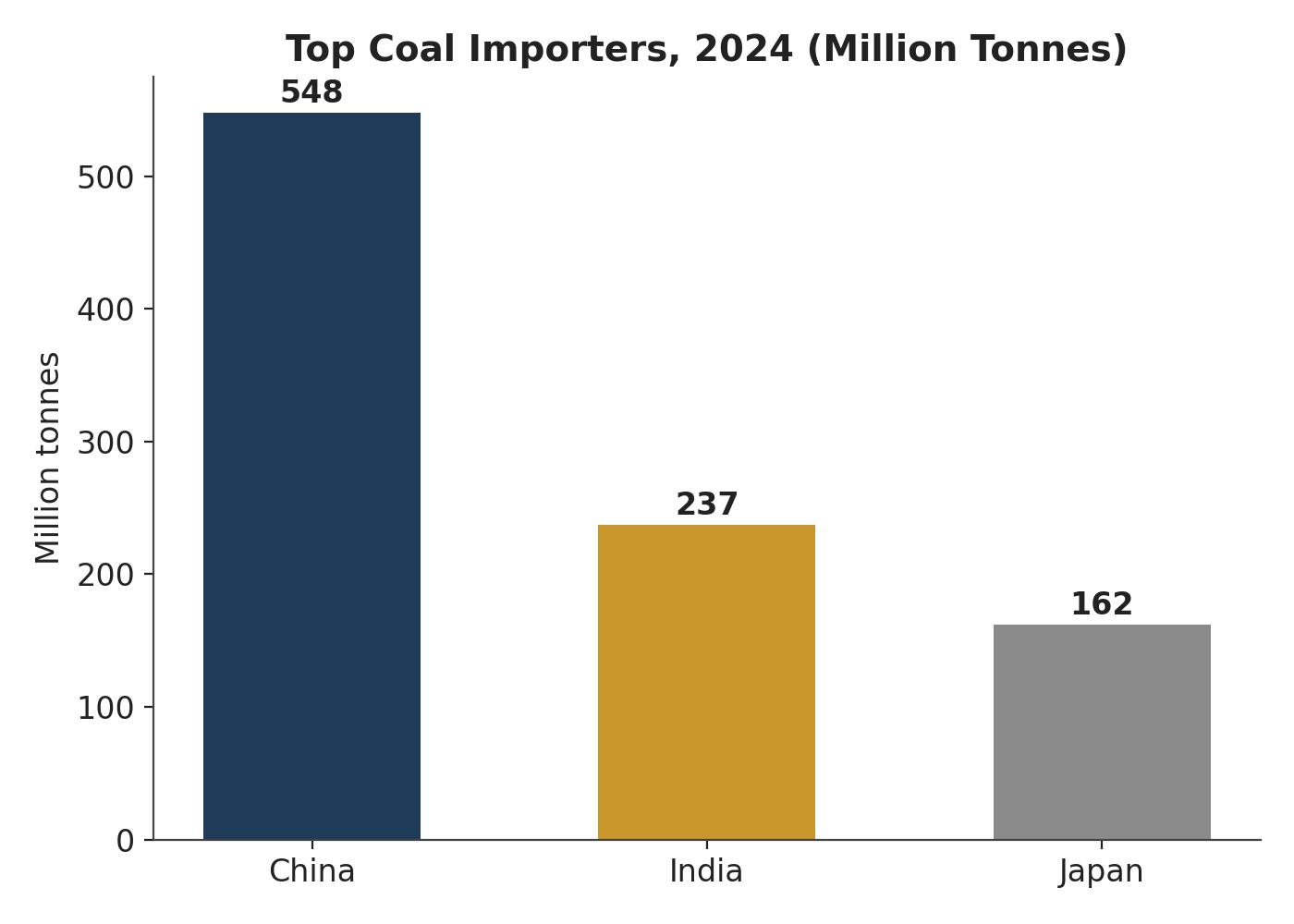
China and India have driven coal demand for two decades, and China is now the swing buyer while India is the rising one. As you can see in the graph (chart1_top_importers_2024), China imported far more coal than any other country in 2024, with India a distant second and Japan third.
Supply versus demand for the decades ahead
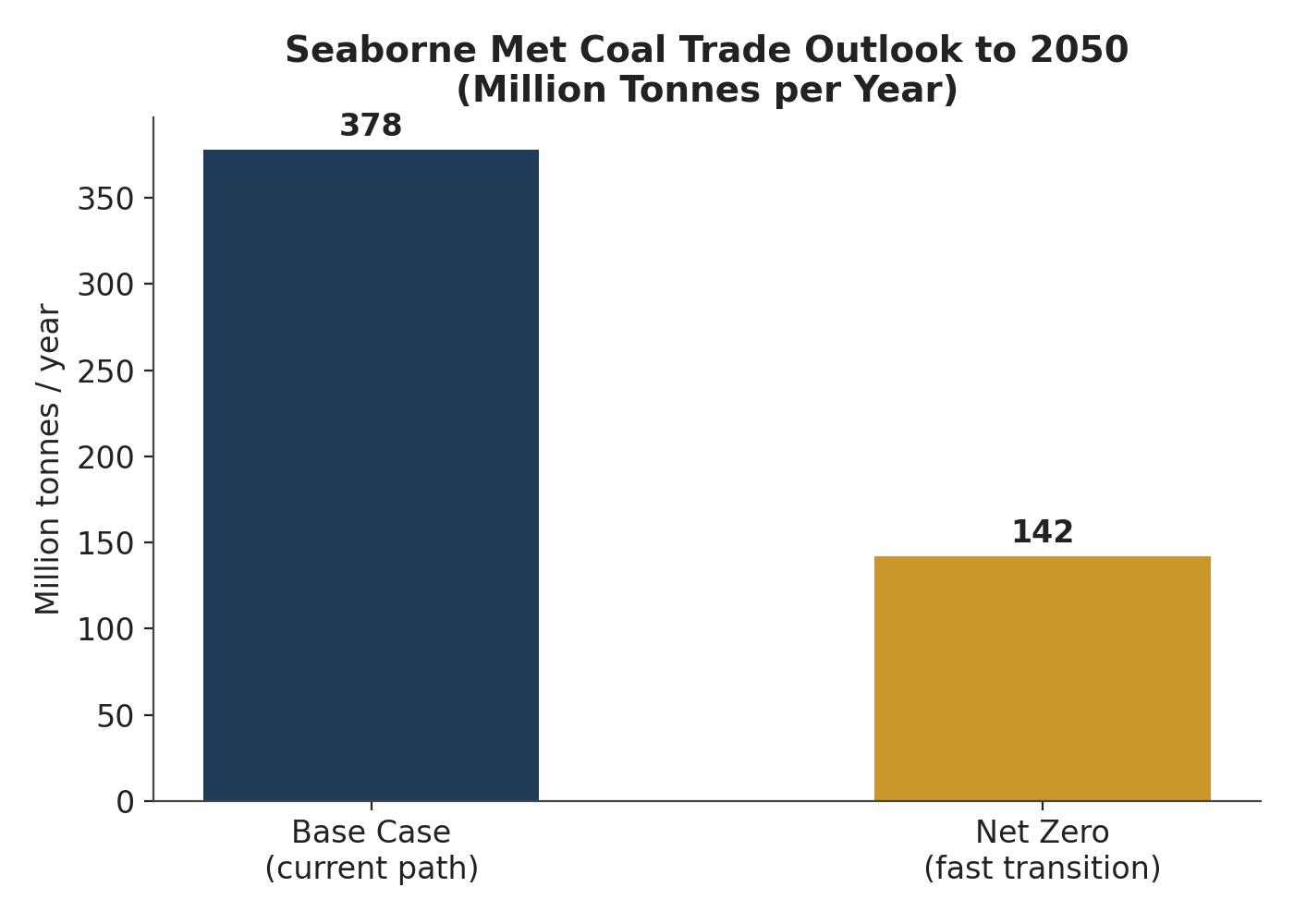
Nobody can forecast 50 years of coal supply and demand with real precision, so the honest picture is a range, not a single number. As you can see in the graph (chart2_longterm_outlook), industry forecasts show met coal trade holding fairly steady in a base case, but dropping by more than half if the world moves fast toward net zero steel.
India, the new demand engine
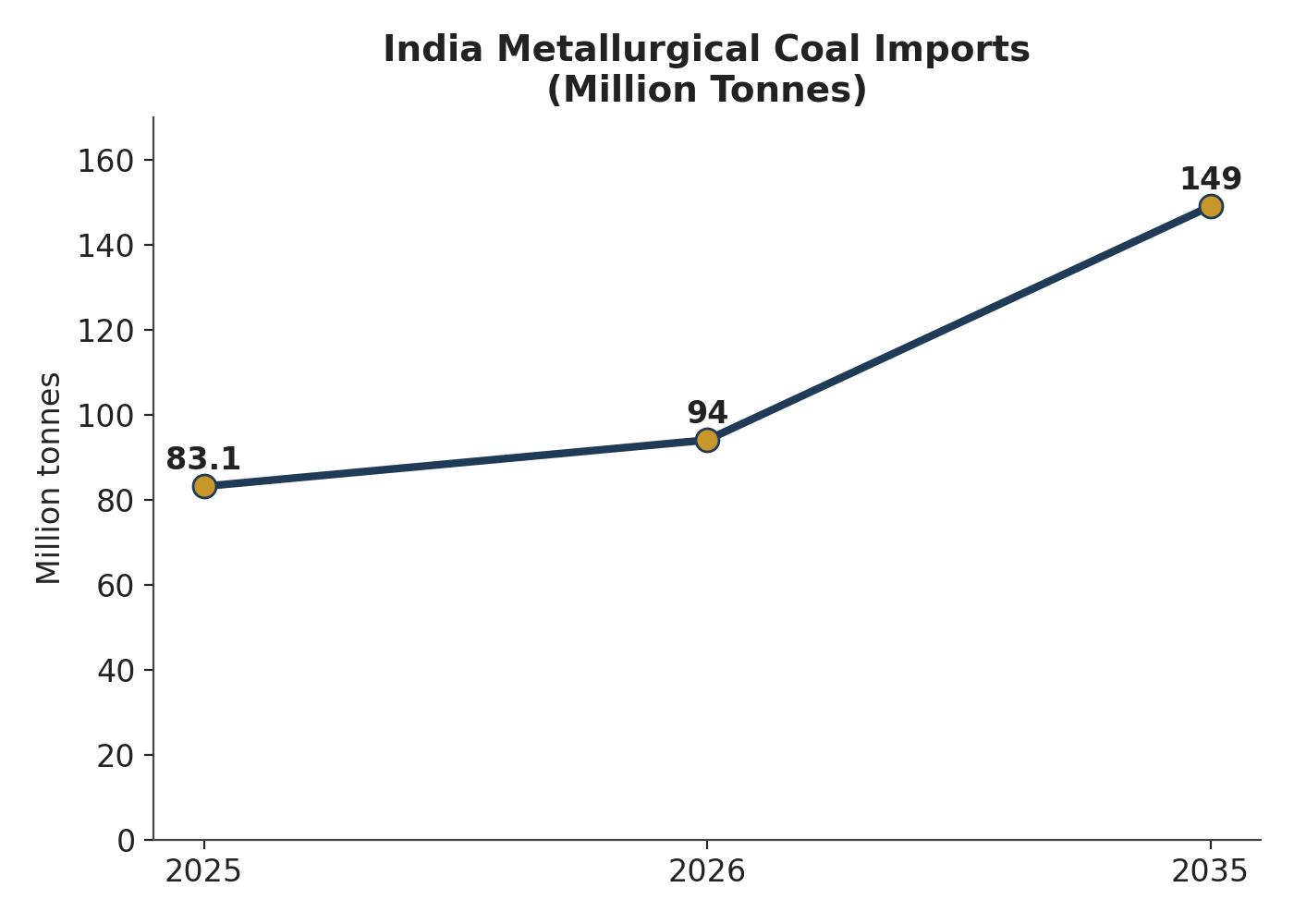
India is where the growth story lives right now, since its steel sector imports 90% of its metallurgical coal and wants to keep expanding output. As you can see in the graph (chart3_india_imports), India's met coal imports are on a steady upward path, roughly doubling between 2025 and 2035.
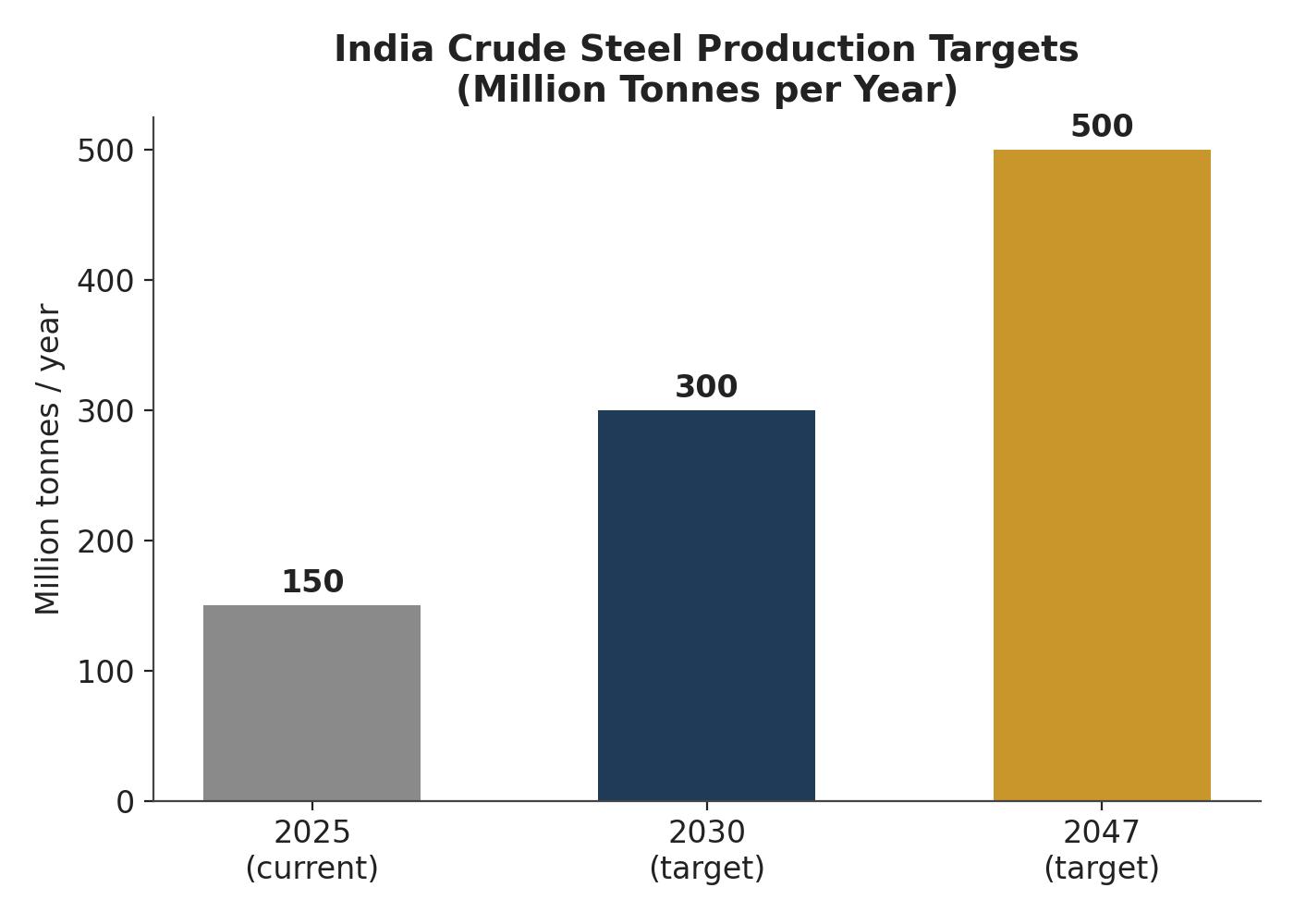
India also has aggressive steel production goals, and most of that growth still runs through coal-hungry blast furnaces. As you can see in the graph (chart4_india_steel_targets), India aims to more than triple its current steel output by 2047.
Putting the case together
Here is the bull case in one place.
Met coal has no real substitute in blast furnace steelmaking, and blast furnaces still make 70% of the world's steel.India is entering a multi-decade steel buildout and is 90% reliant on imported met coal.Rising electricity prices, driven partly by AI data centers, make the electric furnace route more expensive, which favors the coal-based route on pure cost.AI and data center construction is itself adding fresh, durable steel demand.The U.S. government has classified met coal as a critical mineral and a critical material, unlocking permitting speed and tax credits.The golden share in US Steel locks in domestic blast furnace capacity that would otherwise be a shutdown candidate, and that capacity needs coal.Warrior Met Coal and Alpha Metallurgical Resources are both low-cost, low-debt producers that return cash to shareholders through buybacks rather than chasing growth for its own sake.The other side of it
A fair case has to include the risks, because they are real.
Wood Mackenzie's own numbers show seaborne met coal trade could shrink by more than half by 2050 under a serious decarbonization path, from 378 million tonnes to 142 million tonnes.China, the world's largest steel producer, is a shrinking coal importer, not a growing one, and China still sets the tone for global steel and coal prices.Met coal prices are volatile and cyclical. AMR's own 2026 numbers show margins compressing hard when prices dip.HCC no longer trades at a bargain multiple. Much of the good news is already reflected in the price.Steel decarbonization technology, especially hydrogen-based direct reduced iron, is still early but well funded, and it directly threatens long-run coal demand.Bottom line
The pieces line up better for met coal than for almost any other commodity right now. Steady India-led demand growth. A U.S. government actively protecting domestic coal-based steel capacity. Rising electricity costs pushing the economics back toward the old blast furnace route, right as AI adds a new source of steel demand. Two well-run, low-cost, shareholder-friendly producers sitting at the center of it.
This is a real, well-supported case for met coal doing well over the next several years. It is not a sure thing and I'm not a financial advisor, so treat this as the bull case laid out honestly, not as personal investment advice. It's worth weighing against the risks above, and maybe a conversation with a financial advisor, before sizing a position.
(edited)Met Coal: The Quiet Commodity That Could Lead the Next Run in Stock Market?
What is met coal
Met coal stands for metallurgical coal. It is also called coking coal. It is not the same as thermal coal, which power plants burn for electricity. Met coal has one job. It gets baked into coke. Coke is the fuel and the chemical agent that turns iron ore into liquid iron inside a blast furnace. Without coke, most of the world's steel simply cannot get made.
How is Steel Produced: Electric furnace versus blast furnace, and why coal still matters
Here is the part most people miss. There are two ways to make steel.
Blast furnace (BF-BOF). Uses iron ore, coke, and met coal. Makes new steel from raw materials. This route produced about 70.4% of the world's 1.885 billion tonnes of steel in 2024.Electric arc furnace (EAF). Melts down scrap steel using electricity. This route made up the other 29.1% of global output.EAF is often called the "green" route because it skips coal. But EAF has a real weakness. It needs two things in large supply: clean scrap steel and cheap, reliable electricity. Right now, electricity demand is exploding, mostly because of AI data centers and rising cooling and heating needs. Power infrastructure starts are rising more than 21% year over year just to keep up. When power-hungry data centers, EVs, and factories are all bidding for the same electrons, power prices tend to rise. That makes EAF steel more expensive to run, right when the world needs more steel, not less.
Blast furnace steel does not compete for electricity the same way. It runs on coal and ore, which are priced in their own markets and are not tied to the electric grid squeeze. So as power costs climb, the old-fashioned coal-based route starts to look economically sensible again, not just for legacy reasons but on pure cost grounds. That is a real tailwind for met coal that most people are not pricing in yet.
Where met coal ends up
Steel is everywhere, and met coal is the hidden ingredient behind most of it.
Bridges and highways use structural steel beams and rebar.High rises and warehouses use steel frames.Ports, railways, and pipelines all run on steel.Cars, ships, and appliances are steel-heavy products.Wind turbines and transmission towers, ironically, also need a lot of steel.Every tonne of steel made the traditional way needs roughly 0.6 to 0.8 tonnes of met coal, once you count both the coke and the PCI coal. So when you hear that a country is building infrastructure, you are also hearing a call on met coal demand, even if nobody says the word coal.
AI, data centers, and a new source of steel demand
The AI buildout has turned into a steel story too. U.S. data center construction starts went from $14.9 billion in 2023 to $77.7 billion in 2025, a 190% jump in one year. Spending through April 2026 alone hit $49.5 billion, nearly four times the pace from a year earlier. Moody's now projects $3 trillion in global data center spending over the next five years.
Data centers are not just racks and chips. Visit one under construction and steel is everywhere: framing, strut ceiling supports, conduit, piping, racks, cabinets, and wall panels. Add in the power plants, substations, and transmission towers needed to feed all that electricity, and you get a new, durable source of steel demand that was barely on the radar five years ago. New steel demand, even scrap-based steel demand, tightens the whole market and lifts the value of primary steel capacity that still needs met coal.
Coal as a critical mineral
The U.S. government made a formal move on this front. In May 2025, the Department of Energy designated coal used in steelmaking as a critical material under the Energy Act of 2020. Then in November 2025, the U.S. Geological Survey added metallurgical coal to the official 2025 Critical Minerals List, alongside copper, silver, uranium, and eight other materials. Critical mineral status is supposed to go to commodities that matter for economic or national security and whose supply chains are vulnerable, and that are essential to key products.
The U.S. is actually the world's second largest met coal exporter and already produces most of what it uses, so this designation will not fix a foreign dependence problem the way it might for something like lithium. What it does instead is unlock federal permitting speed, financing support, and political protection for domestic coal projects. Congress also made met coal eligible for the advanced manufacturing production tax credit under the 2025 reconciliation law, and the Permitting Council fast-tracked Warrior Met Coal's mines as a transparency project. This is the government putting its thumb on the scale for domestic met coal supply and for the steel mills that use it.
The US Steel golden share connects the dots
This is where the earlier news ties in. The U.S. government now holds a golden share in US Steel as part of the Nippon Steel buyout. That share gives Washington veto power over plant closures, headquarters moves, and any move of production out of the country. At the same time, Congress extended production tax credits to metallurgical coal, the raw material these older integrated mills need for ironmaking. Nippon Steel has already reinvested $350 million into the coal-based ironmaking process at its Gary, Indiana plant.
Put it together and you get a government that will not let a legacy blast furnace plant simply shut down, paired with a subsidy that makes running that plant on coal cheaper. That is about as direct a policy tailwind for met coal demand as you are likely to find.
Global supply and demand, the last 20 years
China and India have driven coal demand for two decades, and China is now the swing buyer while India is the rising one. As you can see in the graph (chart1_top_importers_2024), China imported far more coal than any other country in 2024, with India a distant second and Japan third.
Supply versus demand for the decades ahead
Nobody can forecast 50 years of coal supply and demand with real precision, so the honest picture is a range, not a single number. As you can see in the graph (chart2_longterm_outlook), industry forecasts show met coal trade holding fairly steady in a base case, but dropping by more than half if the world moves fast toward net zero steel.
India, the new demand engine
India is where the growth story lives right now, since its steel sector imports 90% of its metallurgical coal and wants to keep expanding output. As you can see in the graph (chart3_india_imports), India's met coal imports are on a steady upward path, roughly doubling between 2025 and 2035.
India also has aggressive steel production goals, and most of that growth still runs through coal-hungry blast furnaces. As you can see in the graph (chart4_india_steel_targets), India aims to more than triple its current steel output by 2047.
Putting the case together
Here is the bull case in one place.
Met coal has no real substitute in blast furnace steelmaking, and blast furnaces still make 70% of the world's steel.India is entering a multi-decade steel buildout and is 90% reliant on imported met coal.Rising electricity prices, driven partly by AI data centers, make the electric furnace route more expensive, which favors the coal-based route on pure cost.AI and data center construction is itself adding fresh, durable steel demand.The U.S. government has classified met coal as a critical mineral and a critical material, unlocking permitting speed and tax credits.The golden share in US Steel locks in domestic blast furnace capacity that would otherwise be a shutdown candidate, and that capacity needs coal.Warrior Met Coal and Alpha Metallurgical Resources are both low-cost, low-debt producers that return cash to shareholders through buybacks rather than chasing growth for its own sake.The other side of it
A fair case has to include the risks, because they are real.
Wood Mackenzie's own numbers show seaborne met coal trade could shrink by more than half by 2050 under a serious decarbonization path, from 378 million tonnes to 142 million tonnes.China, the world's largest steel producer, is a shrinking coal importer, not a growing one, and China still sets the tone for global steel and coal prices.Met coal prices are volatile and cyclical. AMR's own 2026 numbers show margins compressing hard when prices dip.HCC no longer trades at a bargain multiple. Much of the good news is already reflected in the price.Steel decarbonization technology, especially hydrogen-based direct reduced iron, is still early but well funded, and it directly threatens long-run coal demand.Bottom line
The pieces line up better for met coal than for almost any other commodity right now. Steady India-led demand growth. A U.S. government actively protecting domestic coal-based steel capacity. Rising electricity costs pushing the economics back toward the old blast furnace route, right as AI adds a new source of steel demand. Two well-run, low-cost, shareholder-friendly producers sitting at the center of it.
This is a real, well-supported case for met coal doing well over the next several years. It is not a sure thing and I'm not a financial advisor, so treat this as the bull case laid out honestly, not as personal investment advice. It's worth weighing against the risks above, and maybe a conversation with a financial advisor, before sizing a position.